
Direct printing on carton: Test series yields clear results
Reliably printing on carton packaging poses challenges for many companies, especially when 2D codes must be reliably machine-readable. A comprehensive test series involving over 40 different carton samples now provides solid evidence: The Markoprint integra Singular 108 achieves consistently high readability on common carton grades. The documented results show that the thermal inkjet printer is ideally suited for direct printing on carton while also supporting cost-effective labeling processes.


Challenge: Printing 2D Codes on carton
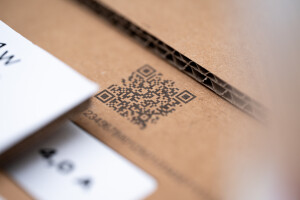 2D codes are becoming increasingly important in logistics, e-commerce, and the packaging industry. Within GS1-compliant marking, two code variants are particularly relevant: the GS1 DataMatrix code and the QR code with GS1 Digital Link. The QR code was selected for the test series. Its high data density makes it more challenging to print and thus a particularly meaningful test subject for evaluating print quality.
However, standard-compliant marking on cardboard packaging often poses a challenge when applied using industrial inkjet printers. Differences in material properties, absorbency, and surface structure can affect readability and thus increase the demands placed on modern marking systems.
Test series using thermal inkjet technology
To evaluate the readability of 2D codes on different cardboard grades under real-world conditions, our development team conducted an extensive test series using the Markoprint integra Singular 108. Various cardboard samples were printed under identical conditions and then tested for machine readability.

Markoprint integra Singular 108
The test series was conducted using the Markoprint integra Singular 108. This high-resolution inkjet printer is designed for direct marking on absorbent surfaces and, with a print height of up to 108 mm, enables large-format print images on carton. It can be easily integrated into existing production lines and is suitable for high print volumes, particularly in logistics, e-commerce, and the packaging, food, and beverage industries.
Test setup and procedure
A total of 44 different uncoated cardboard samples from typical applications in the packaging industry were selected to represent a broad spectrum of industry-standard cardboard materials. Printing was performed using the water-based Singular 1 (HP2041) ink under real-world conditions. The QR codes were then analyzed using professional testing equipment, and their machine readability was evaluated according to international standards for 2D codes: ISO/IEC TR 29158:2011, GS1 General Specification, and ISO/IEC 18004:2006.


Result: 93% A-grade
The results are consistently positive: Approximately 93% of the cardboard samples achieved the top grade of A-grade; the remaining 7%—exclusively particularly challenging cardboard materials—were rated B-grade. The QR codes could be reliably captured on all samples. This test series thus confirms the high print quality of the Markoprint integra Singular 108 as well as its suitability for direct printing in logistics, shipping, and traceability.
Our video on the test series

Quick explanation: What does code grading mean?
To objectively evaluate the quality of 2D codes, they are tested according to international standards. Special verification devices are used for this purpose, which analyze various quality characteristics such as contrast, edge quality, print precision, error correction, and the machine-readability of the code. These individual evaluations result in an overall rating, known as code grading.
The rating is expressed both as a numerical value ranging from 4.0 to 0.0 and as a quality grade from A to F. A value of 4.0 corresponds to the top grade, A, and represents the best possible result. A value of 3.0 corresponds to a B grade and is also considered a very good result. As the value decreases, the code quality gradually deteriorates down to the lowest grade, F.
The higher the grade, the more reliably a code can be read in automated processes. For this reason, A or B grades are often targeted as quality goals, particularly in applications involving logistics, shipping, traceability, and retail.
Cost-Effective: Direct printing as an alternative to labels
The test series shows that 2D codes can be reliably printed on various cardboard qualities. At the same time, direct printing on carton offers economic advantages: Compared to label solutions, marking costs can be significantly reduced. A sample calculation based on one million print images per year illustrates the potential savings. In this example, direct printing with the Markoprint integra Singular 108 reduces marking costs by approximately 76 percent compared to a label solution.
| Method | Cost per 1,000 prints | Annual cost |
| Labeling (thermal transfer printing on satin-finished paper labels) | approx. 10,88 € | approx. 10,880 € |
| Direct printing with Markoprint integra Singular 108 | approx. 2,60 € | approx. 2,600 € |
| Savings | approx. 8,280 € |
The comparison was made between thermal transfer printing on satin-finished paper labels and direct printing using the Markoprint integra Singular 108. The calculation for direct printing is based on a print resolution of 600 × 600 dpi. Under these conditions, a 775-ml ink cartridge for the Markoprint integra Singular 108 can produce approximately 109,000 text prints. The actual costs, of course, depend on the print content, print size, and production conditions.
Conclusion: direct printing on carton delivers impressive results
For companies, these test results mean greater planning reliability when it comes to direct marking of cardboard packaging. The test series confirms the Markoprint integra Singular 108’s suitability for industrial cardboard printing and provides solid evidence of its effectiveness for applications in logistics, shipping, and traceability.
Would you like to evaluate the results yourself? Contact our experts. We’d be happy to conduct a print test on your material. Together, we’ll analyze your labeling requirements and show you the potential that direct printing on carton offers for your application.
